
Sunday Blu
Poets & Storytellers Open Interview Date: 2024/12/13
“I really feel like the work I'm trying to do is from whatever grief I can hold that I can be with, that's my journey. It's just what I got told to do.”
- Sunday Blu
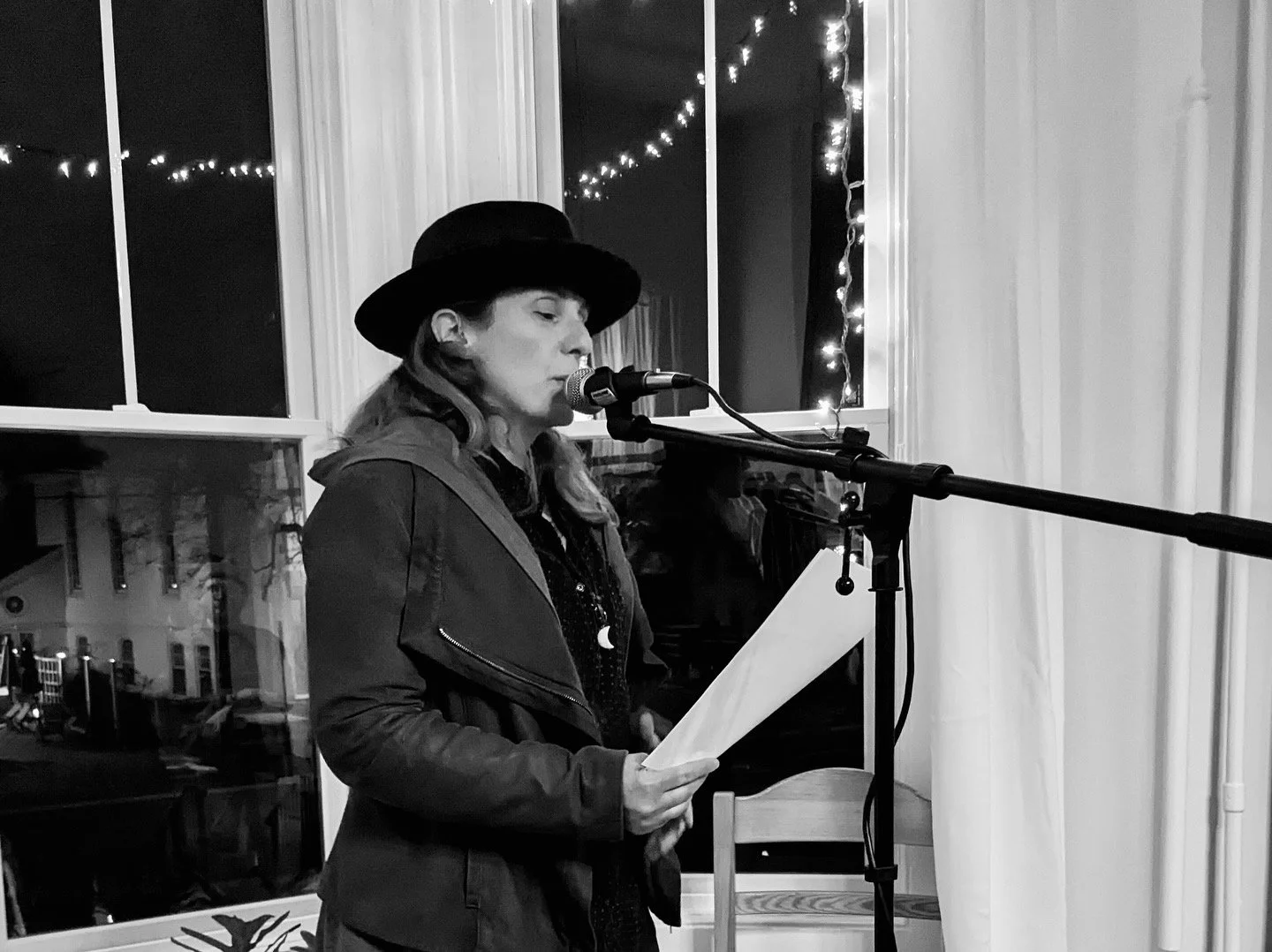
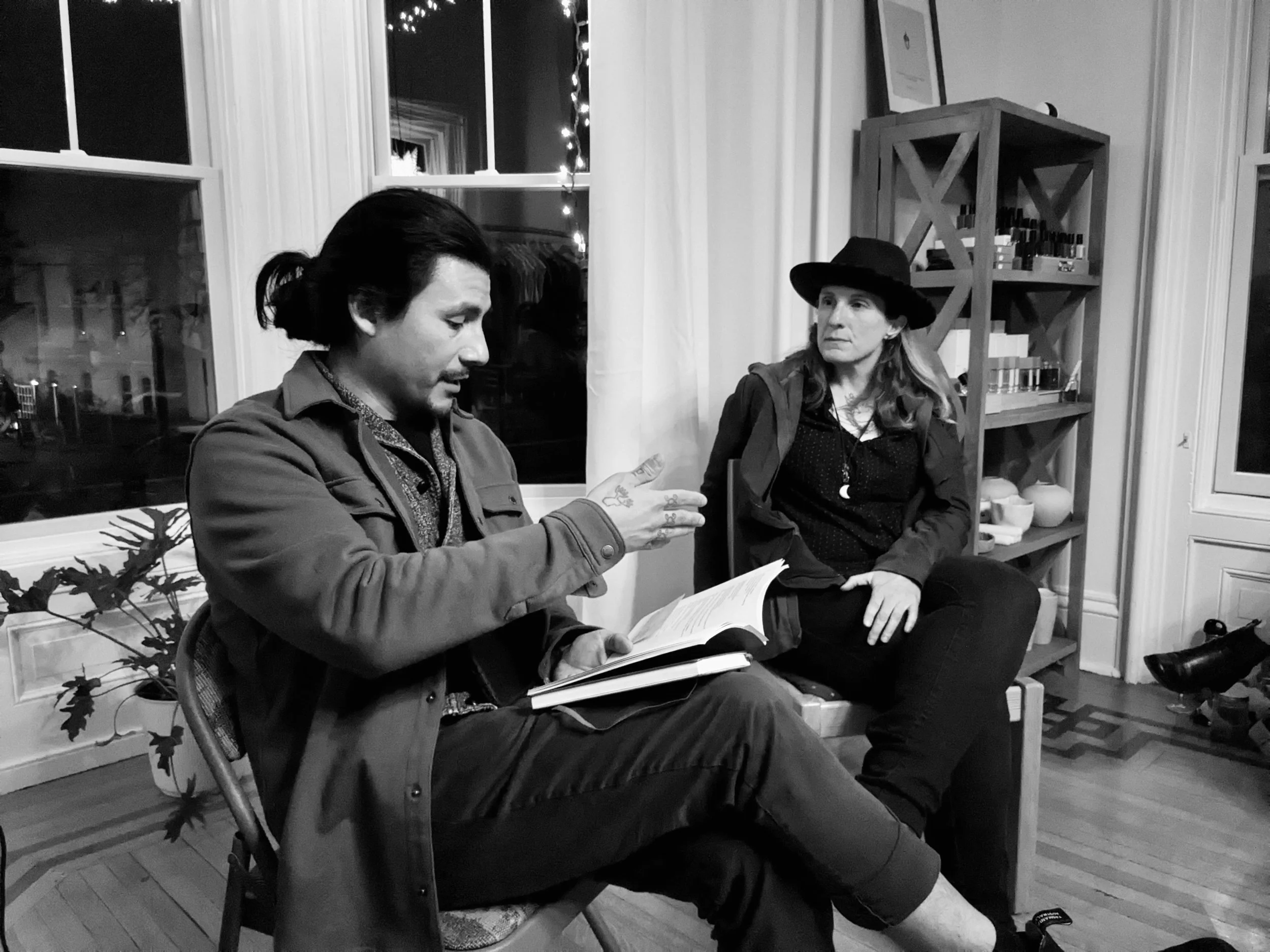
Gregg Yupanki Bautista: Sunday and I met at Flemington DIY’s open mic, and from the first go when I heard her reading I was like “this is awesome.” Just the ethereal-ness and the perspective… It's like where you're the observer, but an observer from a dream space or another space or another reality, because it's not like you're necessarily walking through everything but there's like an intangible quality to what you're describing which I think is really beautiful.
I've been reading your book [In Water Not Blood] from…
Sunday Blu: 2024.
GYB: Ah ok. So one of the things I mentioned before we started tonight was this idea of this other space and this connection to the dream space, and, you know, there's space and time… If you don't mind me reading one portion from a poem of yours called “Let the Hidden Things Be Lost”...
Just listen to how my body bleeds
Listen to how it has for centuries.
I know the only hidden thing worth seeking:
The document of my body–
And how it carries me.
How it sings.
How Stardust becomes a poem.
How Water becomes life,
And Blood becomes soul.
So I really like that because, tying back into what I was just saying, the interconnectedness of all these spaces, of tying in this scientific fact that we are all made of stardust. I was reading this section over and over and over again and I was split into two different trains of thought. The first one is… we have the star, and then the history of the star and its life, and then it dies and becomes our history. Then you as the author exists, live through your experiences, and you create the poem. So essentially you are the Stardust creating more things.
The other side of that is the star and the galaxy and the creation of everything that creates the planet and materiality and experience of all of the otherness that creates you… you create the poem, and then this is also made of stardust. So I think that duality is beautiful and I'm really interested in knowing what role you see the “other space” playing in your poetry.
SB: When you were talking about that, I think the first thing I thought about was that I always sort of felt that we're all kind of born with a certain knowing, and I kind of look for it in other people. And I kind of know what mine is. And when you read that, I was remembering… I think I was born with this essential knowledge of non-otherness, so, that there was nothing that was outside of creation… I know I keep using that word, but whatever word you want to use for “everything.” I mean you couldn't say that something was “not,” right? Because it was here. Does that make sense?
There’s a connectedness that people would say something was unnatural, like we would think of pharmaceuticals or plastic as unnatural. As a kid, I’d always be like, “no, like they're here, therefore they're part of existence and they're part of creation,” so I think a part of me was always trying to pull everything into my understanding of what creation was. Because everything had to be there because it couldn't not be. Like if it was not then it wouldn't be here, you know what I mean?
GYB: Right, and even with pharmaceuticals, so much of modern pharmacology comes from indigenous pharmacology. So nature is the original medicine, which is a beautiful thing to think about. And yea, you talk a lot about nature, which I really enjoy, and in reading [In Water Not Blood], I noticed capitalization of nouns, turning them into proper nouns, which gives power to the thing you're naming…
SB: I think it creates a dialogue, too, it allows you to see it as an entity that you’re in relationship with.
GYB: Yeah, exactly.
SB: So like Water and Sun and Earth and all of those.
GYB: Yeah, and there were a couple really interesting things I jotted down, like Water, Blood, Medicine, Death, Fear, Gods… Like these are all abstract ideas, well, some of them are physical, and others are spiritual, but in giving it that capital letter, that small gesture completely changes the conversation.
Kind of springboarding off of that , the next question that I had is, um… sorry these are all very selfish questions… (Audience laughs)
SB: Can I interrupt before you move to the next one? Because one thing that reminds me of is when you were talking about dreamscapes and altered realities and sort of these places we travel in other worlds, in other spaces, and other consciousness and things like that. One of the things that has always been a natural process that happens for me in an altered state is the nounification of Parts. And it's not the whole Parts thing that everybody's into, it's a little bit more deeper than that… There was this artwork I did early on where it was like the trauma body kind of came outside of me and and that creates a dialogue that you can heal with that part of you, that energetic entity or that space that's within you that's been harmed, or your nervous system has been fucked with or whatever. So the separation and the nounification of something also opened up a lot of healing for me in creating dialogue with these harmed Parts. So it’s not just these gorgeously immense natural phenomenons that you can nounify, but also parts of yourself that you can use your vision to create dialogue with.
GYB: Do you see it as kind of like a self-therapy or…
SB: Yeah, I mean like you said, the indigenous people with the medicine, this has been part of indigenous medicines around the world, this visioning of healing. So yeah definitely a healing process.
GYB: Yea I think that's true and I think also just being in settings like this where you bring those thoughts and ideas and self-reflections into a sphere to share within the space. To me, it's like having time to yourself but then sharing and reflecting with others and spreading those ideas to other people that can also project back onto you, and it comes full circle.
Something I noticed in [In Water Not Blood], there's a lot of recurring motifs like women and wolves and the sea. Are these motifs symbols or referential to something specific to you in your life, or is it more specific like an invented spiritual Pantheon that you make for your writing?
SB: So Women, Wolf, and the Sea… Yeah, well, the Whale’s part of that triad, so The Woman, the Wolf, and the Whale, that’s the first poem. I’d say that’s my Hecate group.
Having the courage sometimes to bring these visionaries into these spaces can be rough because I think medicine has become so devoid of this kind of dialogue and narrative of visionary states being part of the healing process. Coming out and talking about the Woman, the Wolf, and the Whale and these these pantheons that I've created, these are dreaming states, these are altered states, these are conversations I've had in other worlds, in other ether spaces and heart spaces and dream spaces, and visionary states that have really been tumultuous in my life.
I have lived experiences of altered states and psychiatric stuff that was extremely hard to reintegrate as medicine. I think the fact that I spent so much time in the psychiatric system is a reflection of the lack of narrative around a visionary human. So when I made that choice to do that, these things came to me as spirits and guides and characters that I was in dialogue with, you know? The Wolf, I had some beautiful medicine dreams around the Wolf, and I had the beautiful Whale. The Whale is the most amazing creature I've ever experienced in a visionary way. And of course a Woman.
The path of women in the world today… I feel like the beating of that drum needs to get louder, like the music made and the work that women do in the world, I think that needs… Okay, I’m going to get weird… Although I think that the earth needs a masculine gift in this moment, I think women are the ones who need to raise that sound and healing to create the masculine gift, heal the masculine so that that gift can happen.
So it's sort of like a turning of the the wheel a bit, it's not exactly like saying “a woman needs to be more empowered,” it's more like, “no, actually we got to step it up and we've got to get the guys, you know the femme and the masculine.” And also, it's not exclusive to men and women, the feminine and masculine, it can be in anyone and be part of anyone at any moment. So it’s not necessarily essentially biological in my sense, but I just think the feminine needs to step up their empowerment so that they can empower the guys.
GYB: That was great, thank you. Does anyone have any questions you want to ask?
Audience Member (AM) 1: I do. When you were mentioning in the piece about your brother and disagreement, you talk about your relationship with anger, and I'm curious, I guess, about your relationship to anger in all its many forms. So like divine, righteous anger or just like straight up aggression.
SB: I'm actually really glad you've asked me to talk about that in front of a bunch of other people. (Laughs)
AM 1: It's because I trust you!
SB: No, no, thank you, I appreciate that. So… God, where to begin… So, anger for me, I think, the source of it feels as if it's come from a lot of restraining or restriction and coming from the background of having lived experience of forced treatment and psychiatric institutions.The idea of restraining is actually very real, but it existed in my life before that. Growing up, all of us have experienced restraint in our lives, but it just became very real to me when I was restrained in a psychiatric industry and force treated and spent 20 years on medications I didn't want to be on, and all that stuff.
I think everyone every single one of us in in this room can sense what it feels like to be restrained, and there's nothing special about the force with which I tried to come up against the restraint in my life, it was just that I wanted to be heard, I wanted to be felt, I wanted to be in the world freely.
I remember a conversation I was having with my partner at some point, and I was telling her like it's just sometimes like you're navigating through life and you just kind of get these like kicks, like “no, not this, THAT,” and then you say something, “no, not this, THAT,” and it's a lifetime of just like “stop that,” “no, that,” “no, THAT,” and you're just getting redirected constantly from your presence, your free and liberated presence in the world. And I think that has made me so angry in my life. I have worked with it a lot more and been better about it, I'm still not perfectly great, but I mean it's a big feeling, it's a big emotion, anger. But the transformation of that has, especially over the last four years of my life, I mean I think I've done a lot of work to liberate myself from a lot of restraints and that feels good.
But I still get the bite-your-tongue moments. I don't know, I'm just presenting this as a reality that I'm not totally healed in that department, but it takes a lot to have been treated the way I was for so many years and not be ridiculously angry about it. And I think so many people have similar experiences, so it's very human to feel what I felt.
AM 1: I thought you put it beautifully in the conversation with the idea of grace in your work as well, and the way that those things interact with each other.
SB: Yeah, that's the simplest thing I could come up with to be in the world without that anger, is to just look for grace. And if you really look for it, you see it everywhere, you see it all the time, the little tiny itty bitty bits.
GYB: Ok, one more question. Can you explain “getting to the Mississippi River”?*
* ”Getting to the Mississippi River” was Sunday’s written response to the randomizer prompt from the open mic portion.
AM 2: Oh that was really good! Cyclical.
SB: (To GYB) Oh my God, you owe me…
GYB: Is there a whale involved? (Laughs)
SB: This is beautiful, it's just such an honor to be able to share this in this space. So I'm nervous about it because it's been a journey I've been working with for a couple years.
So I started coming off psychiatric meds about like 2019. I was on five different medications and I had been on 17 different medications since I was 21. I've been free of meds for four months now, four or five months, and it's been working out this time. I've had a lot of trouble with it over the years, but I'm finally, you know, feeling pretty secure in myself after all that. So four months free of the psych meds, and I know we're not used to celebrating that but that that is something to celebrate.
(Audience applauds)
So what got me through it was literally connecting to the earth and the rivers and the oceans and planning this ridiculously beautiful journey that I had hoped to make, which is river to river. There's a poem in there, “River to River”… or “Ocean to Ocean,” which is going from the Atlantic to the Pacific. Doing grief prayers and a ritual at each river, so it kind of started with this little jet stone I found on the Atlantic Beach that I broke into four pieces for my family. And one is actually now in a Stonehenge in Sweden. I got the way to the Baltic Sea, so that was a good one because that was like an ancestral trip I took back to Sweden because my family is from Sweden… At least my father's side. And that was intense. Stone henges are intense, I don't care what you believe, they're amazing, they're so so so amazing, and this was an old one right over on the Baltic Sea.
So anyway, water, I collect water from different rivers, I've gone with different people to heal different things, different rivers for different things, like the Ohio was a huge trip for me. I went with my cousins, we had lost their brother, my cousin, to suicide when he was young and that river was a whole bunch of medicine. For the Allegheny, I went with my cousin Tommy, which was another bit of medicine, and the Susquehanna was my brother working out his stuff, the Delaware was a lot of people.
But yeah, the rivers are very healing for me and I’m always going to them. I'm always running into the river or ocean when I'm feeling like I need something. But lately it's kind of funny because every time I go to the ocean, she's kind of like, “just go do your thing, like, shhh, stop coming here, go make a difference.” (Laughs) You know, so the ocean's just been telling me to “go.”
So the Mississippi, long story short, this one feels like a big one for me because my father's mother lived in Biloxi, and my father's mother abandoned him when he was a kid. He was raised by his grandparents and it really, really messed him up in that generational way that passed down to me. So I'm going to try to go to Biloxi, which I think is sort of at the mouth of the Mississippi or somewhere around there. I have to do a little bit more research, but I’m hoping to bring some folks with me and go to the Mississippi and do some prayers down there.
It's for everybody, I really feel like the work I'm trying to do is from whatever grief I can hold that I can be with, that's my journey. It's just what I got told to do.
Back to The Interviews