
Munsif Husami
Poets & Storytellers Open Interview Date: 2025/04/11
“I think learning from each other and being able to empathize with the work… that work is universal. I mean, it doesn't matter if your canvas is a canvas, if it's a blank page, a stage, the work is still the work.”
- Munsif Husami
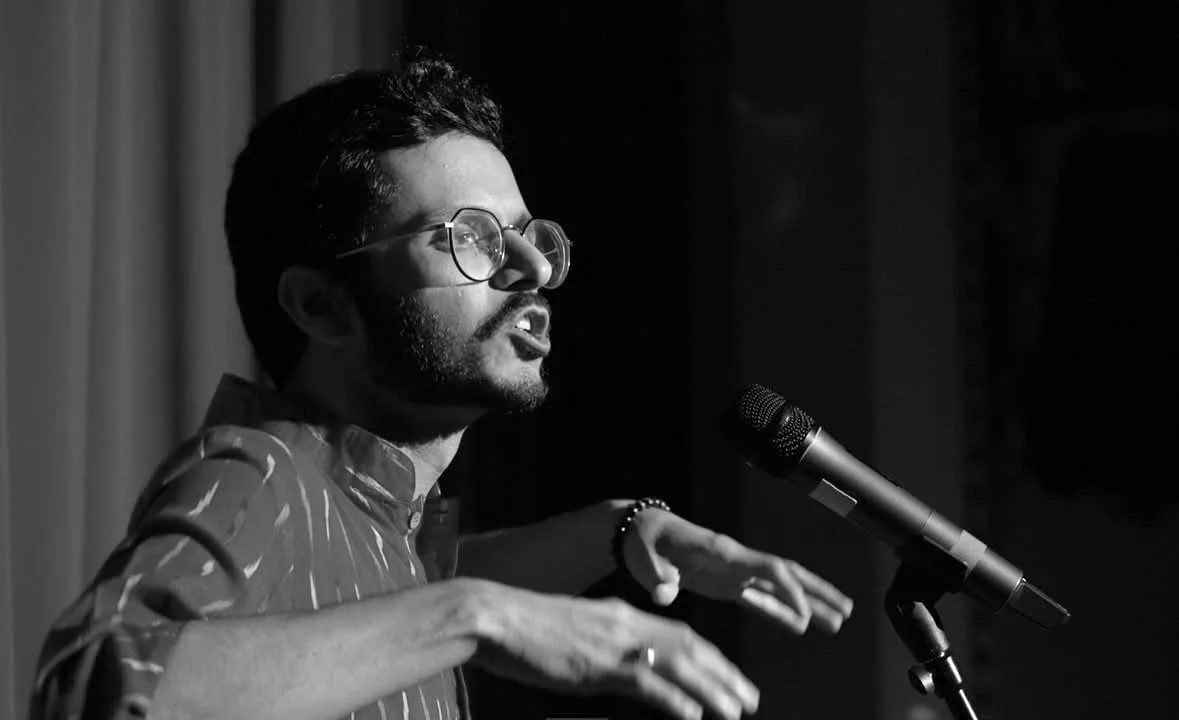
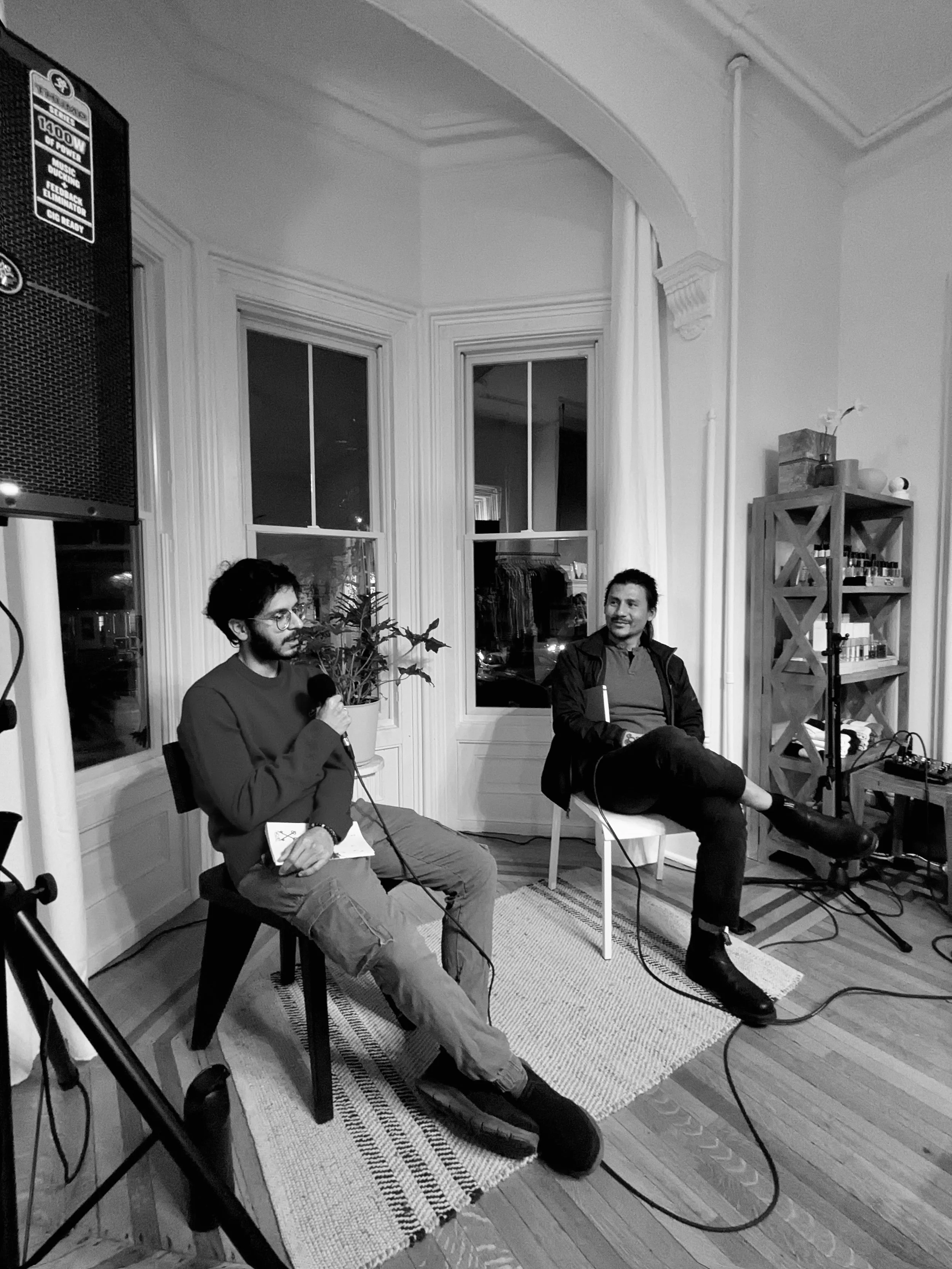
Gregg Yupanki Bautista: Would you consider yourself more of a spoken word artist and performer, or would you say more along the lines of a poet? I feel like sometimes people make some kind of distinction, but there's so much in common.
Munsif Husami: I think I started with writing for the page, but having the opportunity to turn page poetry into spoken word, I think that's a lot of fun. It allows you to capture people's attention and really tell stories in a way that, you know, poetry on the page might not offer. But yeah, I think I like to mix it up.
GYB: And since you’ve been doing this for a long enough time, do you feel like, at this point, you can go into a poem where you start writing knowing “this one's gonna be a performance piece” or “this one's gonna be for the page…” or do you naturally navigate between both of them for for different situations?
MH: I think so, I would say yes. When I do start writing, some pieces pretty immediately sort of stand out to me as, ”okay, this one is either for the stage or it's for the page.” A lot of it has to do with intention, a lot of it has to do with what I want the finished first draft to look like. Sometimes I even try to take a poem which is specifically written for the page and I try to convert it to a spoken word. But usually there's there's very clear indicators. With spoken word, you don't necessarily have as much as much leeway with the audience in terms of communicating, in terms of how many words you want to use. You know, some of that obviously plays a part. But because a lot of it has to do with intention, there's times when I sit down to write page poetry, and others where I let the performance side of my brain take over.
GYB: So to that point of intention and the audience, I noticed that in one of the pieces you performed, you referred to the listener and presented a third a third person perspective, but a lot of your pieces are first and second person perspectives. And during your introduction, we mentioned you talk about social issues and mental health issues and similar topics. Is it a deliberate choice to use more of the “I” or “you” forms of addressing?
MH: So I would say some pieces are written from a first person perspective because some of them have some element of lived experience. But I think that's been one of the most beautiful things about going beyond just writing for the page and engaging myself in performance. Some of the best moments I have is when I share a piece and someone comes up to me or, you know, I see a reaction from the crowd tell me that this is a situation or this is a particular point of life, of lived experience that they can totally empathize with. So I think that sort of feeds into me because it allows me to also be a little more observant as to what kinds of questions are people really looking to answer when it comes to art? Like, not everyone’s necessarily making art because it's their job. We have our jobs to do that. People want to feel life, people want an escape. People want to be left feeling understood. They want to feel empathized with. I think sometimes I just end up sharing something with no indication or expectation, but it ends up connecting with someone, it ends up resonating with them on an emotional level.
I think, in so far as the sort of the choice of pieces between talking about an issue from my perspective versus talking about a social issue that impacts everyone, I like to mix it up and talk about both emotions that are comfortable and emotions that are disturbing. Because sometimes you’ve got to address the elephant in the room. In some rooms, the elephant is getting rather big. (Laughs)
GYB: The elephant becomes the room.
MH: Yeah, so I like that question because that's definitely sort of the approach I take. I do like to have a mix of pieces that can speak to our internal as well as our internal.
GYB: Great, thank you. I have one more question for myself… I'm really excited that you opened your set with “Rare Earth Element” because I think this is such a good poem, not just on the page, but as a performance. Having the privilege of you sharing the page piece with me in advance allowed me to take a moment to look at it line by line and see, just to throw a little bit of theoretical in here, the plasticity that you give time.
So right off the bat, you started off like a little bit of an anxious theme with waking up to your alarm clock and thinking “oh shit I have to go to work.” But it starts with “Four minutes to the alarm, my eyes snap open,” and continuing on, you arrive at, “Grounding myself, I return to my totem.” So you're almost immediately resolving that anxiety with something solid in your life, which I think is beautiful to make that kind of switch. Then as you go on describing it, you're disarming us even more because you start getting us a lot of visual references like streaky sun rays, midsummer morning, the color of her favorite bubble tea. And then you slowly weave back in that anxiety that you still have by just referencing armageddon, yet you acknowledge that your person is still there next to you. The poem, even though it’s performed in about a minute, you (or the speaker) wake up four minutes before the alarm, like, yet there's not a mention of the going back to sleep knowing that you're alarm's gonna go off because I feel the poem builds this space where you know you’re with your person so sleep doesn’t matter because you know that you're just going to go back to dreaming.
What’s it like to approach a poem like this, where it's more focused on a feeling of love that you have for a person?
MH: I think that's a great question because I think for me, being able to write poems like these came from the experiences of this understanding how feeling safe with a particular person can ground you, you know, in times of anxiety in times of stress. And I think in terms of how the approach felt, how the challenge felt to write a poem from this perspective, in my case I think it required me to be a lot more honest with myself.
Like as a sneak peek of my next manuscript, it includes poems that have to do with love—but when I say love, I mean love in every sense of the word. I mean self-love, love for others, even love for people that may no longer be in our lives. And sometimes it might happen to be that most people are not in our lives because things ended up backwards. Maybe you just stopped talking. So there was a very interesting challenge for me to sort of dive into that because in the first chapbook I put out, my aim at the time was to really give pieces that I wrote when I was struggling to build a healthy sense of self, a healthy self image. I wanted to give those pieces of home. And so it only feels natural that, you know, now that I've kind of figured how to do that through this practice of creating something that pays homage to that so I can tackle one of the next major feelings, which is love.
I think about the vulnerability that love demands of us, whether it's platonic, whether it's romantic, whether it's love for family, or love for found family OR lost family, for that matter. I think it's been a phenomenal experience, really working on these. When I began, I thought of it as a challenge and I didn't know if I would naturally be doing well at it. But that’s the thing about art, right? Sometimes it surprises you how just looking in a particular direction can open up your own boundaries.
GYB: Like knowing parameters exist and just working to break those parameters.
MH: Yeah, pretty much.
GYB: Great, thank you. So that’s all the questions from me, let’s open it up to anyone else with questions. Or comments?
Audience Member (AM) 1: I'm very curious about the process of memorizing something to perform it. And I wonder if that's easy for you, or is it difficult? Do you make mistakes? Do you not care if you make mistakes? Do you memorize it as you're writing it? Are you one of those people?
MH: I wish I could memorize it as I'm writing it. But I think that's one of the “unglamorous” tasks of our craft. It’s something that I understand. If it's a piece that I performed a couple dozen times, maybe more, then it becomes easier. I've found myself very fortunate, very privileged to have had experiences where I was given very challenging features, including one time when I had to perform a 30 minute set and I decided to get myself to try and memorize all those 30 minutes. And 30 minutes can be a long time when you're just speaking. So I do have a process that I try to stick with. As for anything new, I don't know, maybe some people are not like this, but with anything new, the most annoying part is the start. (laughs) But I think once you get a little swing of things and especially if I'm committed to memorizing something, if I believe that, “hey, having this one piece memorized for the feature of this show would result in a much more enriching experience for the audience,” then I'm probably going to push myself to do it.
AM 2: HOW can you do it? (laughs) Like repeat the same line over and over, or…?
MH: I mean I try to write a lot. I try to use a lot of tools, but it mostly comes to just writing something down, trying to figure out. Because when you first write something down, especially if it's a first draft, there's so much that you could potentially change. There's so much to it that you could potentially cut out. So a lot of times sounding it out helps as well.
AM 3: I just wanted to thank you for expressing all the creative people that are out there and including everyone. I think that's great. I’ve been an artist for a long time and it seems as though we're always separated. As musicians, and writers, and poets, and painters, we're always separate, but I like the cross pollinations. Thank you for doing it, for saying and speaking it.
MH: You’re welcome, I really appreciate that. I'm honestly glad to be able to do it because I think community is so important, and all of the artists that I've learned from have had a role in my own successes. I hope I’ve had some in theirs as well, but I think learning from each other and being able to empathize with the work… that work is universal. I mean, it doesn't matter if your canvas is a canvas, if it's a blank page, a stage, the work is still the work.
Back to The Interviews